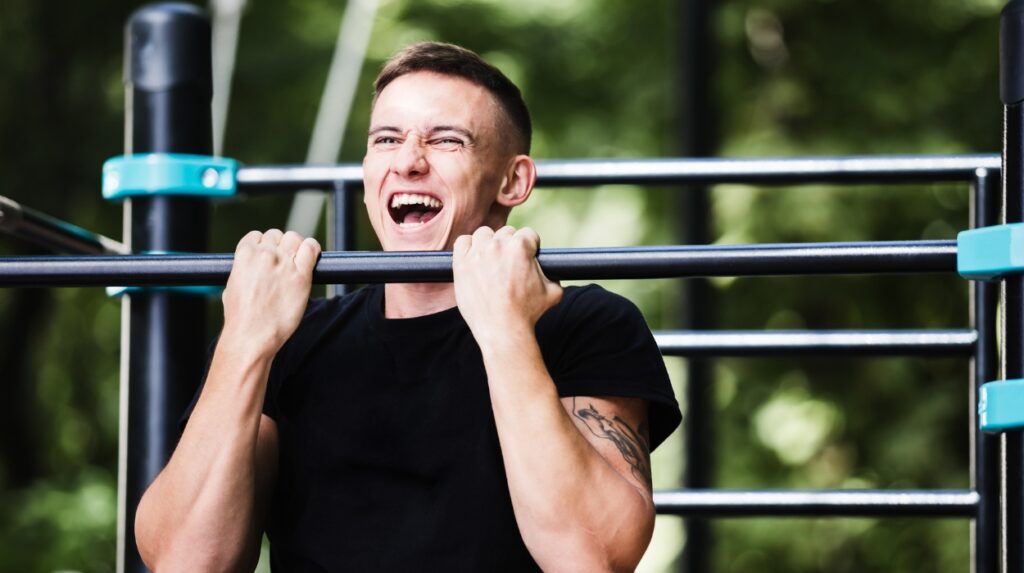
Chin-ups are a premier longevity exercise because they serve as a definitive indicator of functional strength-to-weight ratio, upper-body power, and biological youth. As we age, maintaining explosive power and muscle mass becomes critical for defending against metabolic decline, frail joints, and age-related muscle loss (sarcopenia).
1. Metabolic Protection & Sarcopenia Defense
- Large Muscle Recruitment: Chin-ups target massive muscle groups simultaneously. They heavily engage the latissimus dorsi, biceps, rhomboids, trapezius, and core.
- Sarcopenia Defense: Aging naturally degrades fast-twitch muscle fibers responsible for power. Chin-ups force these high-threshold motor units to fire, preserving youthful physical capability.
- Hormonal Response: Taxing multiple large muscle groups triggers a robust systemic release of growth hormone and testosterone. This chemical surge aids fat loss, bone density, and overall cellular repair.
2. Joint Integrity & Functional Shoulder Mobility
- Decompression: Hanging dynamically unloads and decommissions compressed spinal discs. It counters the hunched, seated postures common in modern life.
- Active Mobility: Moving through a full vertical pulling range of motion restores functional shoulder flexion. This overhead mobility is frequently lost with age.
- Rotator Cuff Stability: The exercise builds balanced scapular control and rotator cuff strength. This stability insulates the shoulder joint against future tears and impingement.
3. Grip Strength as a Longevity Biomarker
- Mortality Predictor: Clinical studies consistently link strong grip strength to lower all-cause mortality, better cardiovascular health, and higher survival rates from chronic diseases.
- Neural Drive: Chin-ups require your hands to support your entire body weight. This demand intensely trains your forearms and nervous system, directly improving your functional grip profile.
4. Closed-Kinetic Chain Efficiency
- Real-World Power: Chin-ups are a closed-kinetic chain movement, meaning your hands are fixed while your body moves through space.
- Neuromuscular Coordination: This requires far greater core stabilization, spatial awareness, and inter-muscular coordination than open-chain exercises like the lat pulldown.
- Relative Strength Indicators: If your body fat rises or your muscle mass decreases, your chin-up performance drops immediately. It acts as an honest, built-in health dashboard.
Longevity-Focused Execution Tips
To maximize wellness benefits while protecting your joints over a lifetime, alter your form using these strategic guidelines:
- Use a Neutral Grip: If straight-bar underhand chin-ups bother your elbows or wrists, use a neutral grip (palms facing each other). This reduces strain on the medial epicondyle (preventing “golfer’s elbow”).
- Prioritize the Dead Hang: Start each repetition from a full dead hang to get the spinal decompression benefits, but keep your shoulder blades slightly packed (engaged) to protect the tendons.
- Control the Eccentric Phase: Do not simply drop down. Lower your body over a controlled 2-to-3-second count to build tendon density and maximize muscle hypertrophy.